


TL;DR
- Call your servicer right away, and also contact a free HUD-approved housing counselor. The worst move is doing nothing.
- Ask about forbearance, loan modification, deferral, repayment plans and reinstatement. Which one fits depends on whether your hardship is temporary or permanent.
- If the payment is permanently out of reach and the home is worth more than you owe, selling is usually better for your finances and credit than foreclosure.
- A cash sale to us means no repairs, no showings, no agent commissions and a closing date you pick, which suits inherited, damaged, or rental homes.
- Never pay anyone upfront to “save” your home. Real help from your servicer or a HUD counselor is free.
Table of Contents
What to do first when you can’t make the payment
The first step is a phone call, and the sooner the better. The Consumer Financial Protection Bureau (CFPB) says to call your mortgage servicer right away. Your servicer is the company that collects your payment. Its number is on your monthly statement, your coupon book or its website. The CFPB also tells you to contact a HUD-approved housing counseling agency at the same time.
Before you dial, get these things together:
- Why you can’t pay. A job loss, a medical bill, a divorce, a death in the family, or a payment that rose.
- Whether it is temporary or permanent. This decides which relief options make sense.
- Your income, expenses and assets. Servicers ask for all three.
- Your loan type. FHA, VA, USDA, Fannie Mae and Freddie Mac loans each have their own relief menus.
HUD funds housing counselors who are free or very low cost. They can explain your options, help organize your finances and speak with your lender for you. You can find one at hud.gov or by calling (800) 569-4287. The CFPB also lists the HOPE Hotline, which answers 24 hours a day at (888) 995-HOPE (4673).
Two more habits help. Open every letter, because HUD notes that not opening mail will not be an excuse in foreclosure court. And if you must cut spending, HUD suggests putting the mortgage right after healthcare, ahead of optional spending and unsecured debt.
What happens when you miss payments
Knowing the clock removes a lot of the fear. HUD describes a typical sequence. The lender contacts you after the first missed payment and is likely to call after the second. After the third, you get a Demand Letter or Notice to Accelerate. That gives you 30 days to bring the loan current before foreclosure can begin. The timeline varies by state.
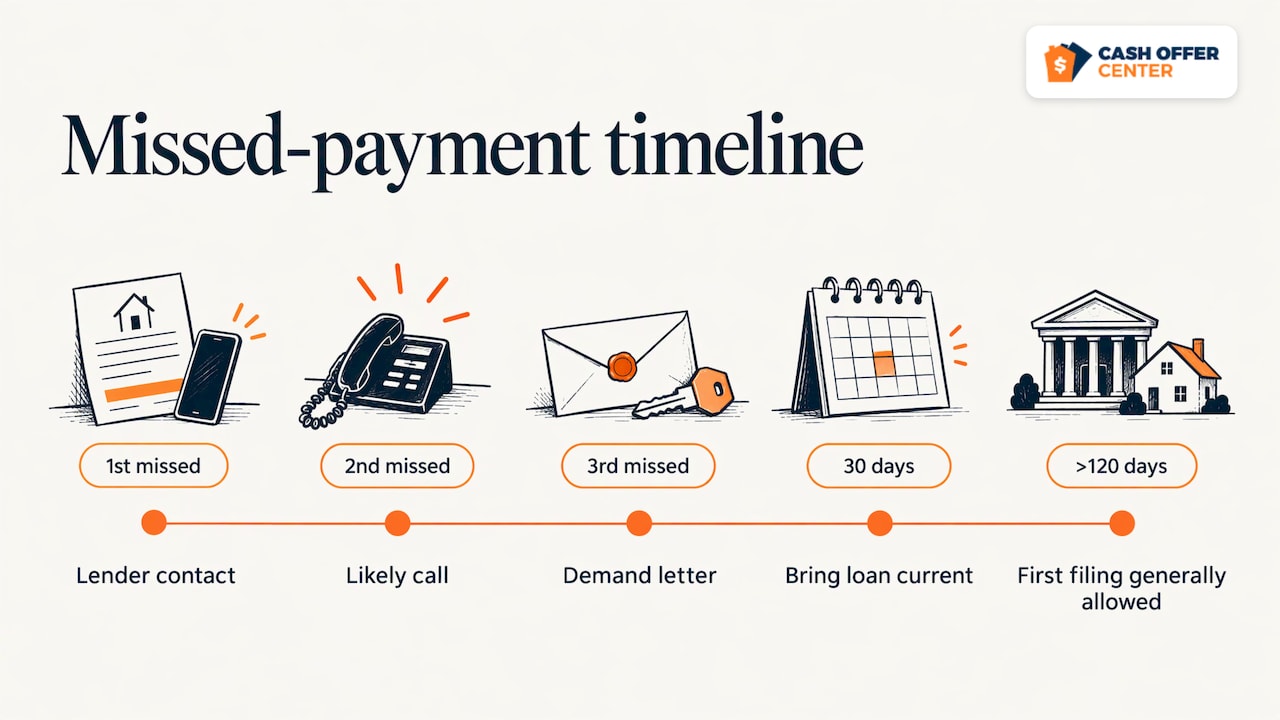
Federal rules add some protection. Under Regulation X, a servicer generally cannot make the first foreclosure filing until the loan is more than 120 days delinquent. A complete application for help, sent in time, must get a written decision. These protections cover your principal residence, and some small servicers and loan types are exempt. That is another reason to talk with a counselor early.
Finishing a foreclosure is costly. A CFPB analysis put the average cost to a homeowner of a completed foreclosure at about $12,500 in 2021 dollars. That covers late charges, title fees, property maintenance and legal fees. The same CFPB analysis notes that a foreclosure stays on your credit report for seven years and can raise the interest rate on future loans.
Once a foreclosure has started, most servicers won’t stop it. Maine Housing, a state housing agency, advises that a workout in place before foreclosure starts makes it unlikely to begin. It also advises that you not move out before talking to your servicer. Acting early is what keeps your choices open.
Relief options to ask your servicer about
These are the tools servicers can offer. Ask about each one by name.
| Option | What it does | Usually fits |
|---|---|---|
| Forbearance | Pauses or lowers payments for a set time | A short, temporary drop in income |
| Deferral | Moves past-due payments to the end of the loan | A temporary setback, now over |
| Repayment plan | Adds a bit extra to regular payments to catch up | Income has recovered |
| Reinstatement | You pay the full past-due amount plus late fees by a set date | You have a lump sum coming |
| Loan modification | Permanently changes the terms, such as rate or length | A lasting payment problem |
| Refinance | A new mortgage pays off the old one | Good credit and enough equity |
The California Attorney General’s homeowner guide defines each of these. It also draws the key line between temporary and permanent hardship. Forbearance suits a temporary income reduction, such as a disability leave with a return date. It does not suit a situation where you cannot afford the mortgage over the longer term. Deferral suits temporary setbacks. Modification suits permanent payment problems.
The details matter. Fannie Mae explains that a forbearance plan can be extended up to 12 months in total. You don’t have to repay everything at once when it ends, and small payments during the plan lower what you owe later. The CFPB’s guide to working with your servicer suggests asking:
- Which options reduce or suspend my payment?
- When are late fees waived?
- Does interest keep building during forbearance?
- What are my rights if forbearance is denied?
- What are my payment options when forbearance ends?
The CFPB also says most homeowners qualify for some assistance if their mortgage is backed by HUD/FHA, USDA, VA, Fannie Mae or Freddie Mac. If you have a VA loan, the VA’s own page lists extra time to arrange a private sale, a short sale or a deed in lieu.
Write down the date and name of everyone you speak with, and follow up in writing.
When selling is the way out
Sometimes the honest answer is that the payment will not fit your budget again. Maybe your income dropped for good, the home needs more than you can spend, or the carrying costs of taxes, insurance and upkeep keep climbing. Then selling is a way to stay in control of the outcome instead of waiting for a lender to take over.
The CFPB’s guidance is clear on the numbers. If your home is worth more than you owe, selling is typically better for your finances and credit than foreclosure, a short sale or a deed in lieu. You don’t need your servicer’s approval to sell, though telling them helps. Fannie Mae likewise says that for a permanent hardship, selling is the best way to avoid foreclosure when the home is worth more than the mortgage and other secured debts.
Work out your equity first
Equity is what is left after you subtract every loan secured by the house from its value. That means your first and second mortgages, any home equity line, and any tax or judgment liens. The Georgia Attorney General’s consumer office notes that a sale before default works when equity covers the full loan balance plus the expenses of selling.
Here is a simple example. Say your home would sell for $600,000 and you owe $480,000 in total. That leaves $120,000 before selling costs. If a conventional sale would cost you commissions, repairs and months of payments, those come out of the $120,000. A direct cash sale with no commissions, fees or repairs keeps more of it in your pocket, and a faster close stops further payments sooner. The numbers above are an illustration, not a quote.
If you owe more than the home is worth
Then ask your servicer about a short sale. In a short sale, the home sells at market value and the servicer accepts less than the balance. You find a buyer, submit a complete application, and get approval from your servicer and any other mortgage holder. Fannie Mae says that depending on the situation, borrowers may qualify for $7,500 in relocation assistance and are relieved of any remaining balance after the sale. Understand the terms and tax effects before you agree.
Taxes on the sale
Most sellers of a primary home owe little or nothing. U.S. News reports that the primary-residence exclusion covers gains up to $250,000 for single filers and $500,000 for married couples filing jointly. Gains above that can be taxed. Talk to a tax professional about your own numbers.
What a traditional listing asks of you
A traditional sale means agent commissions, cleaning, repairs, showings and often 60 to 90 days of waiting while payments keep coming due. When the calendar is the problem, a direct sale to a cash buyer removes those steps.
Inherited homes, repairs, divorce and rentals
Hardship rarely arrives alone. These are the situations we see most often in the homeowners we serve, and what to know about each.
An inherited home with a mortgage. Under the federal Garn-St. Germain Act, lenders generally cannot call a residential mortgage due solely because the home passed to a spouse, child or certain other heirs. Nolo’s legal guide explains that heirs can keep making payments without formally assuming the loan. That does not erase the debt or stop foreclosure if payments are missed. A CFPB rule also lets a confirmed successor in interest ask for loan information and apply for a modification. If you do not want to carry the payments, taxes, insurance and upkeep, selling and paying off the loan at closing is a clean way to settle the estate side. We buy probate and inherited properties as-is.
A home that needs major repairs. Repairs you can’t fund make a conventional sale hard and a payment harder. We buy as-is, so you don’t repair, clean out or stage anything.
Divorce. The mortgage doesn’t disappear with the decree, and one spouse can’t pay it alone. Our guide to selling a house during divorce covers California’s rules and how to time the sale.
A rental that costs more than it earns. Vacancies, bad tenants and repairs can make a landlord’s mortgage unaffordable fast. See how to sell a rental property fast in California. We buy rentals, condos, duplexes, townhomes and multifamily properties.
For a closer look at the mechanics, including payoff and proceeds, read how to sell a house with a mortgage.
How a cash sale to us works
If you own property in California and the payment has become too much, we can make you a fair cash offer. We buy houses, condos, apartments and land. You tell us about the property and your situation, and we explain the offer in full. You choose the closing date, and we can close in as little as seven days. There are no fees, no commissions, and no repairs or cleaning on your side.
We are a local, family-owned team, not a call center or a distant investor. You can start on our main page, or read how the process works for houses, condos, apartments and vacant land. Owners of multi-unit property can see our page for condos, duplexes, townhomes and multifamily properties.
Our view on selling under mortgage pressure
I started this company because I saw how much stress a missed payment can put on a family. The calls and letters come fast, and the clock feels louder than it really is. My advice is always the same. Call your servicer and a HUD counselor first, because they cost you nothing and may open a path to stay.
When the payment simply won’t work anymore, waiting rarely helps. Every month you hold on is another payment, more late fees and a harder conversation later. A sale on your own terms lets you keep your credit in better shape, keep your equity, and decide your own timeline.
That is where we come in. We buy homes as-is, so you don’t repair, clean or stage. You pay no commissions or fees. We explain our offer in plain language, and you pick the closing date. We want you to feel respected and informed, and ready to close one chapter and start the next.
Joe
Stay safe from foreclosure scams
People in hardship attract bad actors. The CFPB is direct on this point: you don’t have to pay anyone to help you avoid foreclosure. Free help is available from your servicer or a HUD-approved counselor. If foreclosure is imminent or you have been served with legal papers, you might also need an attorney. Be wary of anyone who asks for a fee upfront or asks you to sign over the deed. Read everything before you sign, and ask for terms in writing.
FAQ
What should I do first if I can’t pay my mortgage?
Call your servicer right away and contact a HUD-approved housing counselor. Be ready to explain why you can’t pay, whether it is temporary, and what you earn and spend. The CFPB says doing nothing is the worst thing you can do.
How many missed payments before foreclosure starts?
It varies by state and loan. HUD describes a pattern where you get a Demand Letter after the third missed payment, with 30 days to catch up. Federal rules generally bar a first foreclosure filing until the loan is more than 120 days delinquent.
Can I sell my house if I’m behind on the mortgage?
Yes. You don’t need your servicer’s approval to sell, though telling them is a good idea. If the sale price covers the loan balance and costs, the mortgage is paid off at closing. If you owe more than the home is worth, ask your servicer about a short sale.
Does selling to a cash buyer cost me commissions or repairs?
With us, no. We buy as-is, with no repairs, cleaning, fees or commissions, and you choose the closing date. We explain our offer so you know what it covers before you decide.
Will selling help my credit compared with foreclosure?
The CFPB says a sale is typically better for your finances and credit than foreclosure, a short sale or a deed in lieu. A foreclosure stays on your credit report for seven years.
Sources
- CFPB: If I can’t pay my mortgage loan, what are my options?
- CFPB: Avoid foreclosure
- CFPB: How to work with your mortgage servicer
- CFPB: Selling a home as an alternative to foreclosure
- HUD: Avoiding foreclosure
- California Attorney General: Homeowner issues
- Fannie Mae: Mortgage options to stay in your home
- Fannie Mae: Helping borrowers avoid foreclosure
- VA: Help to avoid foreclosure
- Maine Housing: Mortgage help
- Georgia Consumer Ed: Selling your home
- U.S. News: Should I sell my home to pay off debt?
- Nolo: What happens to a mortgage when a spouse dies
Recommended